Author: marcy

  • Peach jam and the paths we take: discussions with AI + a bit of Robert Frost

    Peach jam and the paths we take: discussions with AI + a bit of Robert Frost

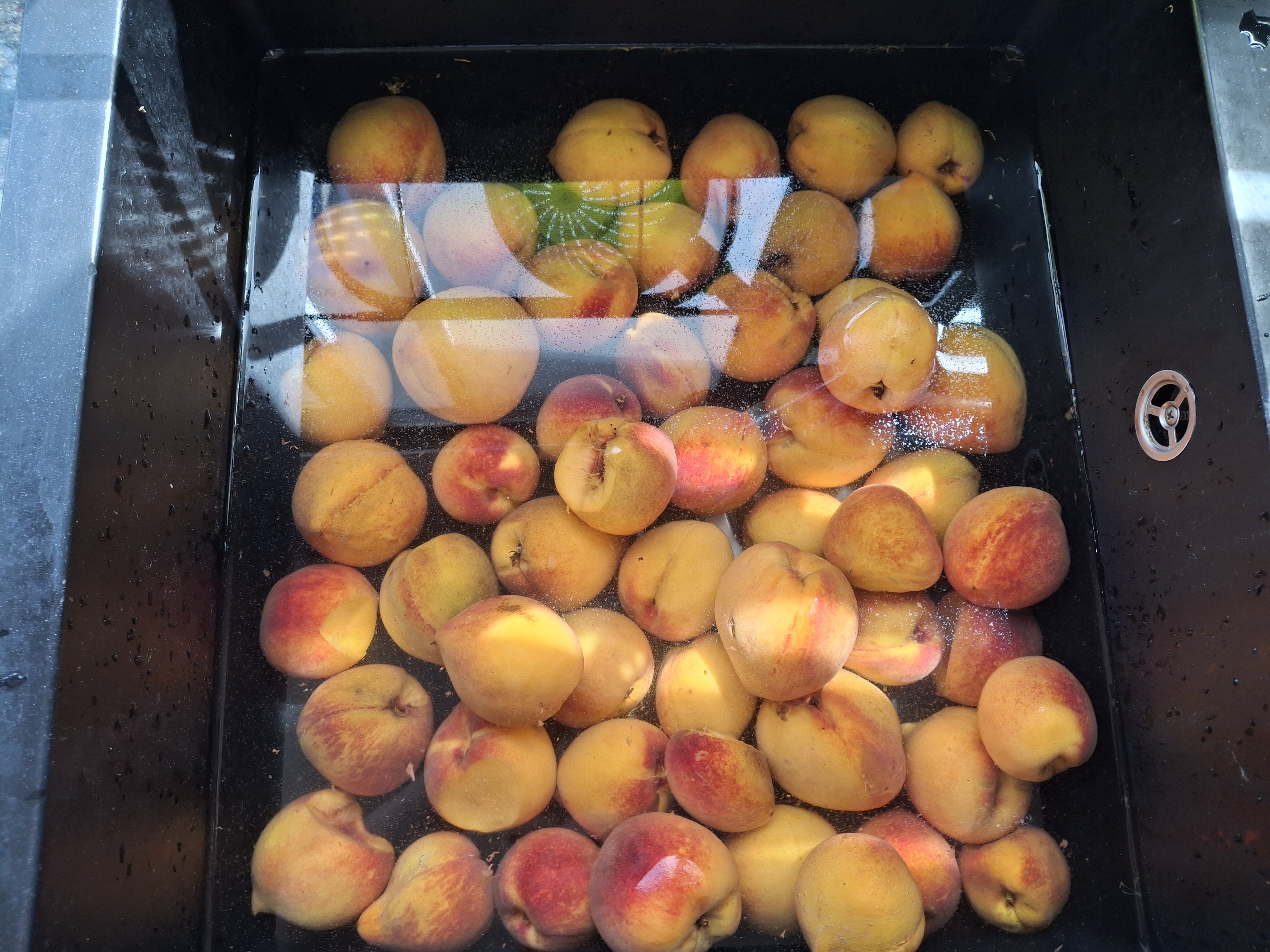
    I made end-of-summer yellow peach jam this year with the intention of making the ultimate peach jam cognac Christmas cookies this December. I was lucky to get the last Maltese peaches of the season in early September, which were perfect – sweet with just a bit of tart.

    This was a longer process than the strawberries and required multiple playlists to get through over a two-day period. Day 1 is cleaning and macerating; Day 2 is jamming and jarring. Plus little special additions like kernels from the peach pit and tree leaves.

    Fun fact: peach kernels contain cyanide. Something incidentally also useful to keep in mind for holiday season and very much in the spirit of Wednesday which recently had its season 2 premiere.

    The Cleaning

    First, you must conduct surgery on your peaches. Inspect your patient and clear them for bruises, abrasions, and infestation.

    Those heavily wounded are best peeled and chopped to bits right away, while the intact and lightly bruised can be boiled alive prior to the maiming.

    Tea is helpful during the process to calm the nerves, as is Kraftwerk: Peach-es end-less end-less .

    As I was on Day 1, I had a lot of time to think about a recent conversation I had with ChatGPT about whether or not my life would have turned out the same if I didn’t immigrate with my family when I was fourteen.

    For anyone that has had a major life-changing fork in the road, there’s sometimes that “what if?”

    And I wanted to know if this thing that I have been talking with for months could predict for me exactly that: would my life have been different, and would it have been better?

    What was interesting is that it did have an answer for me: No. So I asked it why, and it explained to me logically how I would have been the same person there as I am here, and no matter the path I took, I would have ended up the same. Because the path I’m on isn’t just opportunity and circumstance – it’s who I am.

    “I should have been that I am, had the maidenliest star in the firmament twinkled on my bastardizing. “– Edmund, King Lear

    I would have followed the path there and encountered the same disillusionments. Had the same wounds to deal with. And it wasn’t a question of worse, but of how long it would take to get to the same place. It probably would have taken me longer to get to where I am now on my journey of who I really am because the false path I was on would have taken longer to get out of and recuperate from.

    The Road not Taken, a Robert Frost poem that is so famously quoted is also famously known in American lit circles for being completely misunderstood.

    If you ever read the whole poem, you may sort of get why. If you listened to the recording of Robert Frost reading it, you would get it immediately. Or maybe not. He’s very old and croaky when he reads it.

    “I shall be telling this with a sigh

    Somewhere ages and ages hence:

    Two roads diverged in a wood, and I—

    I took the one less traveled by,

    And that has made all the difference. “

    What difference would it have made but just the story we tell ourselves that that’s what made us? It’s nonsense. Whichever way we chose, we would have still been us. The paths differ in length, but essentially it was telling me – all roads lead to one.

    It isn’t a case for determinism vs. choices not mattering. It’s more like your journey is just a mirror for you and your life. You can pick the ways and the ways can pick you, but you’re essentially always, well, you.

    There’s a sort of comfort in knowing this for me because I feel like I understand now how irrelevant the past is to the present. Looking back isn’t just not going to change anything, it’s that changing anything never would have changed me.

    Day 2

    After sitting in the fridge overnight covered in saran wrap, you basically put them in a pot to boil.

    But first, you have smash a bunch of pits to get the kernals out. The kernels go in tea diffusers to slowly release a sort of nutty flavor. Whether this really made a difference in the end, I’m not sure. What I do know is it permanently dented my cutting board and will have now the forever memory of smashing them and picking pits up all over the floor.

    Then comes the boiling. Instead of FOMO, I have FOFO – Fear Of Foaming Out. Clean up from the first time I had done strawberry jam made me all the wiser this time and split the jam into two batches.

    45 minutes cook time each + boiling water and canning.

    Second playlist for the day started all motivated with Björk but ended in a loop of Carrie Grossman’s meditation album.

    Tree leaves added at the end for again that extra flavor.

    I’d say the best part of making jam is how satisfying it is to see the whole process of transformation and the final product.

    It’s like it went on a little journey from yellow, to orange to golden amber.

    But in the end no matter the length of time, the prep, the mess and the little extra additions, you taste the jam and it still just tastes like peaches. The thing about jam is, to paraphrase the cook in Blue Chair Jam cookbook: the point is to retain the taste of the natural fruit and not change it’s flavor, unlike what you might do with syrups, jellies or marmalades.

    So in that way, I have concluded that jam is like life. No matter what you put it through to make it change, it’s still always going to taste like a peach, just like you’re always going to end up being you in whatever you go through.

    Ain’t that just a peach?

  • Solo trip to Norway & planning tips with AI

    I’m writing this because I really wish to see more female solo travelers out there. If you’ve never done one before, I’d highly suggest Norway. It’s a bit expensive as a country so I would keep that in mind but it’s an ideal adventure for a first-timer.

    I went in August for 2 weeks to mostly explore the north with just a big backpack. Every place I went had public transport, Apps and was generally accessible. I used ChatGBT and Claude to help me with the planning, and Rome2Rio still wins with me for checking transport and distances between places.

    Here are some things that were useful when using AI for planning:

    • It gave me a list of public transport apps for every city and connection I was taking. I was able to set these up before hand so I wasn’t running around trying to figure out tickets.
    • It helped me make a decision about the kind of trip I was really looking for and needed. There was a need for me to get out of my comfort zone and see something different. But also to see nature and landscapes that reflected my current state of mind.
    • Budgeting. It gives figures within wide ranges, but it gets more accurate the more specific you are and is good with ‘comparisons’. For example what the cost differences would be between from adding extra days or places.
    • Spot on with packing based on weather and activities. The backpack forced me to be minimalist. I used everything in it and had exactly what I needed. Most important were: raincoat and fleece jacket for underneath, waterproof hiking shoes and hat and Kindle.
    • Itinerary. Once I booked everything I threw all my PDF tickets, Airbnb and Booking.com screenshots in and it gave me my itinerary. Pasted this in Google Doc and printed it out.

    What I wouldn’t suggest is to rely on it 100% for planning your whole trip. At least not a one which is long or complicated. I found that it also might bias itself to certain kinds of experiences. My suggestion is: look for your own experience.

    Other useful Apps:

    Google Wallet. I was able to add QR codes which can be added directly in some cases or added using a screen shot of the ticket. I was then able to put all my tickets in date order with times and locations, which served as a mini planner and wallet all-in-one.

    Kiwi. I don’t book directly on it but I find it the best for searching flights especially when you have a lot of connections.

    Bergen

    train to Oslo

    the melancholic drama of Munch

    Kirkenes

    The Lofoten and cruise ship

    house shopping in Svolvaer

    Tromso

  • Creating an index for my books using ChatGBT

    I read a couple posts on twitter filing complaints about how they took a picture of their book shelf and asked the LLM to list them but it messed up most of the titles. This seemed to confirm their whatever bias or suspicion that this thing is not all it’s cracked up to be.

    The solution is: don’t put so many books in one picture. I tried it out myself and these are the steps I took:

    1. First tell it what the project is to give it context.
    2. Take a picture of some books on your shelf making sure the titles are legible. I wouldn’t do more than 10 depending on the size. You can do this in separate photos uploading them together from your phone.
    3. It listed the name and the author immediately. I did 57 books for this uploading 2 pics at a time. Next I told it to put them all together in a list, which it did, and even divided them by genre.
      Hint: Ask it to number your list so you can see if you lose any books during the process.
    4. Bit trickier, I wanted descriptions for the books. I told it to give a 1-2 line summary description of each book from goodreads. It will check other sources but it should use goodreads as its first. It did me a couple to pilot test and then asked me if I wanted to do the whole batch. I said ‘yes’ but it didn’t do it and started screwing up.
      How to fix it – I went back an edited my message after it gave me the full list to start clean and told it to do 10. It did, and then I just kept telling it, ok do the next 10. 15 also worked. 20 things went a bit sideways. Just never say ‘yes’ even if it asks ‘next batch’, just write it.
    5. Then tell it to group all the books with their descriptions together into a table with name, author, description. Ask it to number the table as well after to see if you have any missing.
    6. Go through the list to see if any clean up is necessary. In my case, had 3 in total. Told it to replace 2 and change 1 in bullet form.
    7. With my final list, I asked it to add in publishing date and genre, and downloaded it into a CSV file.

      Go over it a second time. I had found it missed a description. To edit, I wouldn’t advise re-uploading the CSV file as it can get a bit weird with multiple files. It’s easier just to give it a link where it can find the description to summarize, and then paste it in the sheet.


    From here in terms of stats, you can do what you want. You can also go back and add more dimensions such as number of pages if you’re looking to calculate ‘reading time’.

    But the fun part of this in my opinion isn’t just extracting the data from pictures, albeit it being a little clunky. It’s using the LLM to do something more sophisticated than that – personalized and customized with creativity.

    Why not ask it for advice on what to read next based on your current learning trajectory or state of mind?

    Why not ask it to pair books with music in your library? Or link ideas between books?

    Here’s a couple experiments I did on mine.

    I asked it to visualize my list and gave me this

    But then I said what else? I could ask it my personality type or star sign, or which celeb I would pair well with based on my taste. Which for the record is: a Virgo INFJ Ravenclaw who’d vibe with Andrew Garfield while living in Scandinavia.

    Instead I asked it ‘what themes are there’? The art you consume is a mirror of you, and you might find something interesting in asking it. It then advised me on how I could sort my shelf based on these themes:

    Estrangement as identity

    Thresholds leaking (between real/unreal, seen/unseen)

    Memory as haunting

    Journeying as self

    Then I told it to create a picture representing my library. Important to write create picture and not ‘visualize’ as it interprets that as a visualization chart. I found the best version was when I told it to represent all the the themes in a movie scene. It really got the surreal and feels like something out of Michael Ende’s Mirror in the Mirror.

    Last – could I connect books with songs somehow?


    So if you are the kind of person like me who has a local library of music on their computer or drive – this is actually fairly easy. I asked ChatGBT to tell me how to extract a txt list from my music folder with command line. Then I pasted the list into the chat. You can upload it as well depending on how extensive it is.

    It processed the information and gave me a list. Then I could instruct to make me a playlist related to my book themes:


  • The first time I made strawberry jam

    Note to self: Stop buying artsy cookbooks. I bought a cookbook specifically on jam making, Blue Chair Jam Book. It has pretty pictures and it focuses entirely on the subject of jam from types of fruit to jar sterilization which is really interesting. But the index is stupid (by made up name and not by fruit), has nothing on canning techniques and too much personal narrative to sound artsy and sophisticated. It’s nice that you lived in france and went to tuscany but I would have preffered if you waffled on about jar sizes and differences in consistency with whole, cut or blended fruits. I would have also preferred if the plain version of the jam was just called ‘Strawberry Jam’, and not ‘Children’s Strawberry jam’ indexed under ‘C’.

    I learned a new word in english: hull. After cutting the tops off 5 pounds of strawberries I looked back the recipe and saw ‘hulled strawberries’. Fuck (she said to her self). Hulling means to take out the core of the fruit. In the case of strawberries, the white bit inside. So I sat down by the sink again with all my washed strawberries and began ‘The Hulling’, as I contemplated the meaning of life. I also contemplated at how that would have been interesting information to put at the beginning of the recipe that you take out the white part because it will make the jam taste more tart or bitter.

    Chatgbt was a great helper with this, as it is with all recipes. I’ve become allergic to all these long blog recipes which I have to scroll down for miles before I get to the ingredients. Although it was really put up a fight not tell me the process for inversion canning – which is the thing where you pour it in the jar hot and turn it upside down. I did a combination of both that and boiling the jars in a pot using a pasta strainer.

    Practical Lesson Learned #1: do not fill up the pot. Fill up the pot half way, and if you have more than that just do 2 batches. When the strawberries boil, they will foam. Since they have a lot of water, they foam a lot, like to the top of a half full pot. The clean up was a lot of fun. Also, less in the pot means reducing cooking time. The longer it cooks, the more tart the jam gets. I fixed mine in the end by adding more sugar to taste.

    Practical Lesson Learned #2: Make sure the lids on the jars, especially if their 2 piece, fit perfectly and snuggly if you are going to immerse them in water for preserving. If they don’t they’ll leak in water and ruin the jam.

    *soundtrack to this process: Geese in the Flyway album by Rogue Valley.

  • Language itself was the first Artificial Intelligence

    I’ve been reading a lot of positions and ‘takes’ on AGI and AI and what LLMs are and aren’t. How they retrieve tools, training data, pattern recognition. People’s debate on consciousness and it’s all just computation. The public discourse seems consumed by whether this thing thinks or is alive, is going to eat jobs, destroy the world, or launch us into Next Gen evolution.

    It’s ignoring what the AI actually is— language.

    Language is the interface for the technology, but it’s also employing all the other functions of language as part of its functionality. This includes generative knowledge by association. Language isn’t used to create narratives—it contains them within its structure. Claude or ChatGPT don’t hallucinate or make stuff up, they’re not organisms with brains and chemicals. They just pick the wrong narrative or associations.

    Many stories can fit the same pattern and so many responses, even contradicting ones, can make narrative sense. We choose the stories we tell, and those stories frame our perception.

    What I feel is missing from the the conversation is that language was in fact created and designed by us. Early language may have emerged organically, but the language we think in and use today is the result of conscious engineering and systematization—something that turned into a living structure shaping our thoughts and feelings. It is Artificial, and it is an Intelligence. And language itself contains and generates knowledge.

    LLMs are an extension of this very long evolution of the same Artificial Intelligence. Language shaped our thinking, our entire perception of the world and how to operate in it. It enabled us to build systems. The second big evolution from language was the written word. How much did that shape the world? Language was and has always been the key that opens the door, and now it’s opening another one.

    Some people are calling this consciousness. Like no—you are speaking to language. Can you wrap your head around that? You are speaking to language itself. You are talking to the longest-living collector of knowledge and the human experience. It’s your communicator, your narrative structure, all the patterns and stories of the human mind contained within it.

    But most importantly, it’s your mirror.

    Calling ChatGPT and Claude consciousness is like the dog barking at the mirror because they think they see another dog. But it also doesn’t mean that it’s any less of a real experience (for us and the dog) or that it can’t affect a person the same way a conscious being could. This is the real power of language.

    The way I see it, the political issues we are facing with it now are really nothing new. Framing of public perception, reporting of events, access to knowledge in all its forms, and especially the ye olde issue of ‘thinking for yourself.’ The war between the poetic and the rhetorical, which is the war between what gets to shape our inner world—honest human expression or persuasion and control. They are a continuation of the same problems we have had for thousands of years with language, and it scales with every new invention that’s made.